
Table of Contents
- Two Terms, Significant Overlap
- Wall Paneling: The Interior Standard
- Wood Cladding: Interior and Exterior Use
- Where the Terms Overlap
- Key Differences at a Glance
- Which Term Should You Use When Searching?
- Explore the Full Range
- Key Differences: Cladding vs Wall Panelling at a Glance
- Cladding vs Wall Panelling FAQs
Two Terms, Significant Overlap
Wood cladding and wall paneling are used almost interchangeably in everyday conversation — and in many contexts, they refer to essentially the same thing: timber-based boards or panels applied to cover a wall surface. But there are meaningful distinctions in how each term is typically used, which applications they apply to, and what kind of products they describe.
Wall Paneling: The Interior Standard
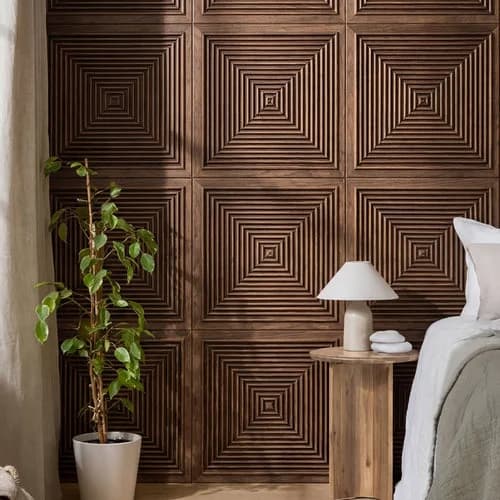
Wall paneling traditionally refers to interior wall treatments using pre-manufactured panels — whether solid timber, engineered wood, MDF with veneer, or other composite materials — installed flat against a wall surface to improve aesthetics, add texture, or provide acoustic performance.
Wall paneling encompasses:
- Acoustic slat panels and decorative slat panels
- Fluted and reeded panel systems
- Wainscoting and dado rail systems
- Shiplap and tongue-and-groove boarding
- Geometric tile panels (hexagonal, mosaic, herringbone)
The term is almost exclusively used for interior applications.
Wood Cladding: Interior and Exterior Use
Cladding — particularly wood cladding — has a broader scope. It refers to any material applied to the exterior or interior surface of a structure to provide protection, insulation, or aesthetic character. The word “cladding” implies a covering function — you’re cladding the structure beneath.
Wood cladding typically refers to:
- Exterior timber boarding (weatherboard, shiplap, larch, cedar)
- Exterior composite cladding designed to replicate timber
- Interior wood wall treatments with a more structural or architectural emphasis
- Commercial interior cladding systems
For exterior wood cladding ideas and material options, our outdoor wall cladding ideas guide covers the full range of exterior materials.
Where the Terms Overlap
In practice, a timber slat wall in a living room might be described as either “wood wall paneling” or “interior wood cladding” by different people or brands — and both would be technically defensible. The overlap is real.
The practical distinction is usually:
- Paneling implies pre-manufactured panel units installed as a system
- Cladding implies individual boards or elements applied directly to the structure, often with more of a construction character
Key Differences at a Glance
| Feature | Wall Paneling | Wood Cladding |
|---|---|---|
| Typical location | Interior only | Interior and exterior |
| Format | Pre-manufactured panels | Individual boards or panels |
| Primary purpose | Aesthetic and acoustic | Protection, weathering, aesthetic |
| Installation | Often adhesive-based | Often mechanically fixed |
| Acoustic options | Yes (felt-backed panels) | Rarely |
Which Term Should You Use When Searching?
For interior applications — living rooms, bedrooms, home offices — search for “wood wall panels” or “acoustic wall panels.” You’ll find pre-manufactured panel systems designed for interior adhesive installation.
For exterior applications — garden walls, building facades, outbuildings — search for “exterior wood cladding” or “composite cladding.” You’ll find products rated for weather exposure and mechanical fixing.
For a full overview of what the interior category covers in terms of materials, styles, and installation, the wood panel wall complete guide is the right starting point.
Explore the Full Range
Browse the complete wood wall panel collection at The Panel Hub — covering both decorative interior panel systems and the RockSurface® exterior cladding range. For design inspiration across interior panel applications, our interior slat wall ideas guide shows 50+ real-room treatments that illustrate the difference between panel styles in practice. The acoustic panel buyer’s guide explains the acoustic panel subcategory in detail — the type of wood panel most commonly confused with soundproofing cladding.
Key Differences: Cladding vs Wall Panelling at a Glance
The core distinction comes down to primary purpose and installation context. Cladding is an exterior-facing material whose primary function is weatherproofing and thermal performance — the aesthetic is secondary to the structural role. Wall panelling is primarily decorative, installed on interior wall surfaces to add visual depth, texture, material warmth, or architectural character.
This functional difference drives every subsequent specification choice. Exterior cladding must be rated for UV exposure, rain penetration, and freeze-thaw cycles. It requires specific fixing systems that accommodate thermal expansion and contraction. It is subject to building regulations in most jurisdictions and needs to comply with fire performance standards.
Interior wall panelling operates in a controlled environment. It does not need to resist moisture ingress or UV degradation in the same way. It can use thinner profiles, lighter substrates, and adhesive-based fixing systems that would be completely inappropriate on an exterior wall. The trade-off is that interior panels, moved outdoors, will fail rapidly — and exterior cladding installed indoors will typically be over-engineered, expensive, and dimensionally inappropriate for the application.
There is, however, a genuine overlap category: materials designed for both interior and exterior use in covered or semi-exposed conditions. PVC cladding systems, composite decking profiles used as cladding, and certain treated timber profiles can perform acceptably in sheltered exterior conditions and provide a seamless visual language between inside and outside in open-plan properties with large glazed openings.
Cladding vs Wall Panelling FAQs
Can the same material be used for both cladding and interior panelling?
Some materials are specified for both applications. Composite WPC profiles, certain stabilised timber species (like thermally modified ash or Accoya), and powder-coated metal cladding systems work in covered exterior and interior contexts. However, standard interior MDF, moisture-resistant MDF, and standard veneer panels are not suitable for any exterior application — they will degrade within one season without protection.
Do I need planning permission to change exterior cladding?
This varies by jurisdiction and property type. In the UK, exterior cladding changes on a house are generally permitted development unless the property is in a conservation area, is listed, or unless the cladding is in a material that falls outside permitted development rules (stone, artificial stone, pebble dash, render, timber, or plastic are all treated differently). Always check with your local planning authority before committing to exterior cladding changes.
Is wood cladding high maintenance compared to interior wood panels?
Yes, significantly. Exterior timber cladding requires periodic treatment (oiling, staining, or painting) every three to seven years depending on species, exposure level, and finish type. Untreated hardwood species like cedar and larch silver beautifully but require eventual maintenance to prevent surface checking. Interior wood panels in natural oil finishes require re-oiling every one to three years — a much simpler maintenance regime in a controlled indoor environment.
What fire rating applies to interior wall panels vs exterior cladding?
Both interior and exterior applications are subject to fire performance requirements, but the specific requirements differ. Interior panels must comply with surface spread of flame standards (Class B or C in most European regulations). Exterior cladding is subject to more stringent rules in buildings above 18m in height (post-Grenfell fire regulations in the UK), requiring non-combustible materials or Class A2 fire performance. Confirm the fire rating of any panel product before specifying it for either application.