
The honest answer is: it depends entirely on which type you buy. Wall panels span a range from $1 per square foot for basic MDF to $40+ for solid hardwood — and those numbers reflect completely different products that shouldn’t be compared directly. A guide that just says “wall panels cost $7 to $25 per square foot” isn’t useful because it mixes materials that serve different purposes at different quality levels.
This guide breaks down actual 2026 pricing by material type, gives you realistic project budgets by room, explains what drives cost up or down, and tells you where DIY saves real money versus where it doesn’t. All prices are US materials costs unless noted, current as of April 2026.
Table of Contents
- The Short Answer: Cost by Panel Type
- What Drives the Price Up (and Down)
- Real Project Costs: Room by Room
- DIY vs Professional Installation: Where the Difference Is Real
- What You’re Really Comparing: Cost Per Year
- Hidden Costs to Factor In
- How to Calculate Your Project Cost
- Is It Worth It? Wall Panels vs the Alternatives
- Frequently Asked Questions
- Where to Start
- Get an Accurate Price for Your Project
The Short Answer: Cost by Panel Type
If you’re here for a quick number, here it is. These are material costs per square foot — what you pay for the panels themselves before installation.
| Panel Type | Materials (per sqft) | What You’re Getting | Typical Lifespan |
|---|---|---|---|
| Paintable MDF (fluted, ribbed) | $7–$11 | Engineered wood, no grain, needs painting | 10–15 years |
| PVC / WPC panels | $7–$15 | Waterproof, lightweight, printed wood-look | 10–20 years |
| Shiplap / beadboard | $2–$7 | Traditional pine or MDF planks | 10–20 years |
| Wainscoting / board and batten | $7–$20 | Classic paneling style, painted finish | 15–25 years |
| Wood veneer slat (decorative) | $12–$18 | Real wood face, no acoustic backing | 15–25 years |
| Acoustic slat panels (SoundPanel) | $14–$22 | Real wood veneer + NRC 0.85 felt backing | 15–25 years |
| Solid wood planks / cladding | $15–$40+ | Through-and-through timber, ages beautifully | 30+ years |
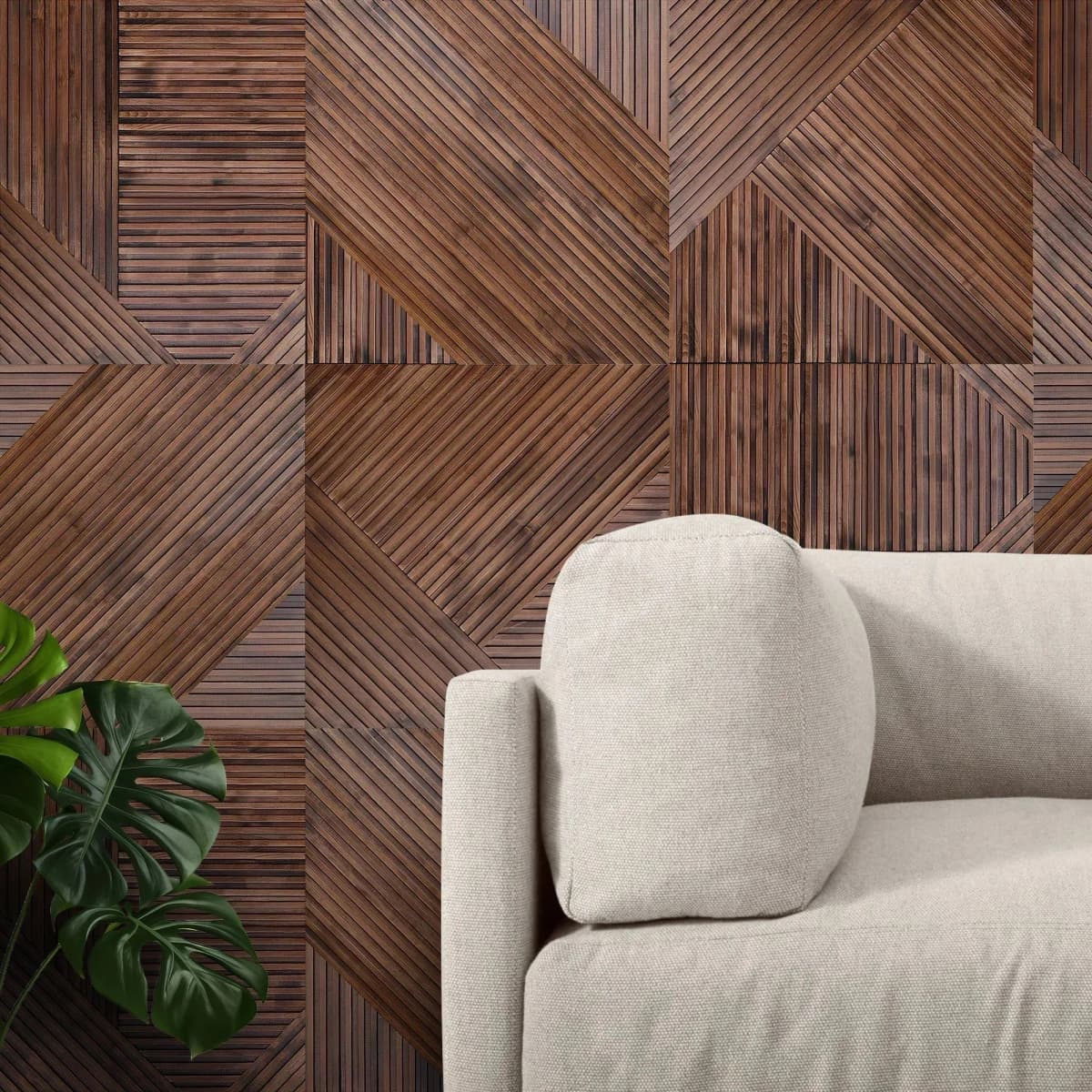
| 3D mosaic / geometric (solid wood) | $18–$35 | Solid wood cut into patterns, statement walls | 20+ years |
| Faux stone / textured panels | $6–$14 | Lightweight composite, stone-look finish | 10–15 years |
| WPC outdoor cladding | $10–$18 | Weather-resistant wood-plastic composite | 20–25 years |
Add labor if you’re hiring a professional: $3–$10 per square foot for standard flat-wall installations, rising to $8–$15 for complex layouts, high ceilings, or intricate patterns.
What Drives the Price Up (and Down)
The material type explains most of the cost variation, but these five factors also shift your final number significantly.
1. Real Wood vs Engineered vs Synthetic
This is the biggest cost driver in the category. Real wood — solid or veneer — costs more than MDF, which costs more than PVC. The price premium is real and justified: solid wood lasts decades, improves with age, and has grain character no printed surface replicates. Wood veneer gives you real wood appearance at lower cost and weight. MDF and PVC give you shape and texture at the lowest cost but without genuine wood material.
If you see two “wood panels” priced at $8/sqft and $18/sqft, they are almost certainly different materials — not the same product at a markup. Solid wood vs MDF: full comparison.
2. Acoustic Backing
Acoustic slat panels cost $2–$5 more per square foot than the same panel without acoustic backing. That premium pays for high-density felt (AcuFelt 1500 g/m² in TPH’s case) that delivers NRC 0.85 — absorbing 85% of sound energy hitting the surface. If acoustics matter to your room, this is one of the most cost-effective upgrades available. If acoustics genuinely don’t matter, decorative slat panels at the lower price point are the right call.
3. Wood Species
Within real wood panels, species is a major price variable:
- Pine: Lightest cost. Pale, knotty, casual aesthetic.
- Oak (white or red): Mid-range. Clean grain, highly versatile, the default choice for good reason.
- Walnut: Premium. Darker, richer, more dramatic — and priced accordingly. American Walnut is among the most expensive domestic hardwood species.
- Charcoal / ebonized: Treated or deeply stained — can be any underlying species, but the finishing process adds cost.
4. Pre-finished vs Unfinished
Pre-finished panels arrive ready to install — no priming, painting, or staining required. Unfinished panels (most MDF, some solid wood) need finishing after installation, which adds material cost (primer, paint, or stain) and time. Factor at least $1–$3/sqft in finishing materials for unfinished panels, plus the labor time if you’re hiring it out.
TPH’s wood veneer panels are pre-finished. No on-site painting required.
5. Coverage per Panel and Waste
Panels that cover more wall per unit are cheaper to install because you’re handling fewer pieces and making fewer cuts. Always add 10–15% to your square footage measurement for waste — cuts, mistakes, and off-cuts that can’t be reused. Use the Box Calculator to get an accurate panel count with waste factored in.
Real Project Costs: Room by Room
These are realistic all-in estimates for single-accent-wall installations at each room size — materials only unless noted. Measurements assume standard 8ft ceiling height.
Home Office Accent Wall (approx. 80–100 sqft)
| Panel Choice | Materials | Pro Install (est.) | Total DIY | Total with Pro |
|---|---|---|---|---|
| Paintable MDF fluted | $560–$1,100 | $240–$1,000 | $560–$1,100 | $800–$2,100 |
| Decorative wood veneer slat | $960–$1,800 | $240–$1,000 | $960–$1,800 | $1,200–$2,800 |
| Acoustic slat (SoundPanel) | $1,120–$2,200 | $240–$1,000 | $1,120–$2,200 | $1,360–$3,200 |
The home office is where acoustic panels pay for themselves fastest. One wall treated with NRC 0.85 panels removes the flutter echo that makes video calls sound hollow — a quality-of-life improvement you notice every working day. Office and gaming room setups.
Bedroom Headboard Wall (approx. 90–120 sqft)
| Panel Choice | Materials | Pro Install (est.) | Total DIY | Total with Pro |
|---|---|---|---|---|
| Paintable MDF fluted | $630–$1,320 | $270–$1,200 | $630–$1,320 | $900–$2,520 |
| Decorative wood veneer slat | $1,080–$2,160 | $270–$1,200 | $1,080–$2,160 | $1,350–$3,360 |
| Acoustic slat (SoundPanel) | $1,260–$2,640 | $270–$1,200 | $1,260–$2,640 | $1,530–$3,840 |
| Solid wood cladding | $1,350–$4,800 | $450–$1,800 | $1,350–$4,800 | $1,800–$6,600 |
A full-height slat panel behind the bed replaces the need for a headboard and creates a hotel-suite quality backdrop at a fraction of custom millwork cost. Bedroom panel ideas.
Living Room Feature Wall (approx. 120–160 sqft)
| Panel Choice | Materials | Pro Install (est.) | Total DIY | Total with Pro |
|---|---|---|---|---|
| Paintable MDF fluted | $840–$1,760 | $360–$1,600 | $840–$1,760 | $1,200–$3,360 |
| Decorative wood veneer slat | $1,440–$2,880 | $360–$1,600 | $1,440–$2,880 | $1,800–$4,480 |
| Acoustic slat (SoundPanel) | $1,680–$3,520 | $360–$1,600 | $1,680–$3,520 | $2,040–$5,120 |
| 3D mosaic (solid wood) | $2,160–$5,600 | $960–$3,200 | $2,160–$5,600 | $3,120–$8,800 |
Home Theater (approx. 200–300 sqft across 2–3 walls)
| Panel Choice | Materials | Pro Install (est.) | Total DIY | Total with Pro |
|---|---|---|---|---|
| Acoustic slat (SoundPanel) | $2,800–$6,600 | $600–$3,000 | $2,800–$6,600 | $3,400–$9,600 |
| Fabric-wrapped acoustic panels | $600–$2,400 | $600–$3,000 | $600–$2,400 | $1,200–$5,400 |
Fabric-wrapped panels are cheaper but purely functional — grey rectangles on your wall. Acoustic slat panels at higher cost also redesign the room. For a home theater you’re investing in anyway, the look matters. Home theater guide.
DIY vs Professional Installation: Where the Difference Is Real
Labor is the most controllable variable in your total cost. Here’s where DIY genuinely saves money and where it doesn’t.
Where DIY saves significantly
Acoustic slat panels on flat drywall walls. This is the easiest possible installation scenario — adhesive, level, saw for the end cuts. TPH’s SoundPanel is specifically designed for this. Most people finish a standard accent wall in under 2 hours on their first installation. Skipping professional install on a $2,000 materials project saves $300–$800 in labor. That’s a meaningful number. Full slat panel install guide.
Single accent walls without complex cuts. No outlets, no corners, no ceiling angles — straightforward rectangular walls are where DIY is fastest and cleanest.
Where professional installation is worth the cost
Full room treatment across multiple walls. Once you’re covering three or four walls with precise alignment and corner joins, a professional finishes faster and cleaner. The cost difference narrows when you account for your own time.
Solid wood planks. Heavier material, more precise fitting required, no felt backing to absorb minor wall imperfections. Solid wood on an uneven wall needs skilled preparation work.
Complex spaces. Stairwells, vaulted ceilings, arched walls, lots of outlets and switches — complexity multiplies DIY time and error risk.
What You’re Really Comparing: Cost Per Year
The per-square-foot number is not the whole story. Lifespan changes the real cost significantly.
A $9/sqft MDF panel that needs replacement in 12 years costs $0.75/sqft/year. A $18/sqft wood veneer acoustic panel that lasts 20 years costs $0.90/sqft/year. A $30/sqft solid wood panel that lasts 35 years costs $0.86/sqft/year. The differences in annualised cost are smaller than the upfront price gap suggests — and the real wood options add value to the property in a way MDF doesn’t.
This doesn’t mean always buy the most expensive option. It means the $9/sqft vs $18/sqft comparison isn’t as straightforward as it looks when you account for what you’re actually buying and how long it lasts.
Hidden Costs to Factor In
These are the line items that surprise people mid-project.
Adhesive: $8–$20 per tube, one tube covers roughly 30–40 sqft of panel. A standard accent wall needs 2–4 tubes. Budget $20–$60 for adhesive on a single wall. Adhesive guide.
Trim and edge strips: Internal corners, external corners, and top/bottom trim strips give panels a finished edge. Budget $2–$5 per linear foot of trim, and measure your perimeter before ordering.
Baseboard removal and reinstallation: If you’re going floor-to-ceiling, the baseboard needs to come off first and be reinstalled against the panel face. Simple DIY task — pry bar and a few nails — but plan for it.
Paint and primer for MDF panels: Unfinished MDF needs at minimum one coat of primer and two coats of paint. A litre of quality primer runs $15–$25, a litre of wall paint $20–$40. Budget $50–$100 in finishing materials per accent wall for MDF panels.
Waste allowance: Always order 10–15% more than your measured square footage. Cuts produce off-cuts you can’t always reuse, and measuring errors happen. It’s significantly cheaper to have a panel left over than to place a second order and wait for shipping.
Samples: TPH sample boxes let you test finishes in your actual room under your actual lighting before committing to a full order. A $20–$40 sample cost that prevents a $2,000 material mismatch is money well spent. Order samples.
How to Calculate Your Project Cost
Three steps:
Step 1 — Measure your wall area. Height × width of each wall you’re panelling. Subtract any large fixed openings (doors, windows) if they take up more than 20% of the wall area. For most accent walls, measure the full rectangle — the material cut around an outlet is wasted but the calculation is simpler.
Step 2 — Add 12% for waste. Multiply your square footage by 1.12. That’s your material order quantity.
Step 3 — Apply the per-sqft rate for your chosen panel type. Use the tables above for a realistic range, or use the Box Calculator for a precise panel count based on TPH’s specific panel dimensions.
Example: a 10ft × 9ft bedroom headboard wall.
- Raw area: 90 sqft
- With 12% waste: 101 sqft
- At $18/sqft (acoustic slat panels): $1,818 in materials
- DIY install: your time (1.5–2 hours)
- Pro install: add $270–$900 depending on your area
Is It Worth It? Wall Panels vs the Alternatives
The honest comparison is not just material vs material — it’s what you get per dollar spent relative to alternatives.
vs Paint: Paint a room for $200–$500 including labor. It changes the color but not the texture, adds no acoustic benefit, and has no impact on how the space feels spatially. Wall panels at $1,500–$3,000 for an accent wall do all three things paint can’t. They’re not competing products — they solve different problems.
vs Wallpaper: Good wallpaper runs $3–$12/sqft plus $3–$7/sqft professional installation — comparable mid-range cost to wood veneer panels. Wallpaper adds pattern and some texture but remains a flat surface with no acoustic benefit, and removal is a project. Wood panels are permanent in the best sense: they age well, they’re repairable, and they add genuine material value to the room.
vs Custom millwork: A custom built-in wood panel wall from a finish carpenter runs $50–$150/sqft installed — three to eight times the cost of TPH’s pre-finished acoustic panels at comparable visual quality. The difference is manufacturing: TPH panels are precision-engineered in a factory and arrive ready to install. Custom millwork is built on-site, priced accordingly.
vs doing nothing: A bare drywall room with hard floors reflects sound, looks unfinished, and adds no value to the property. One well-chosen accent wall — $1,200–$2,500 all-in for a typical room — is one of the highest return-per-dollar improvements available in interior finishing.
Frequently Asked Questions
What’s the cheapest way to panel a wall?
Paintable MDF panels at $7–$11/sqft materials, installed DIY. Shiplap pine is cheaper still at $2–$7/sqft but the aesthetic is more rustic and the install is more time-intensive. For a clean, modern look at the lowest cost, MDF fluted or ribbed panels are the entry point.
How much does it cost to panel a 12×12 room entirely?
A 12×12 room has approximately 384 sqft of wall area (four 12ft × 8ft walls). Subtract doors and windows — realistically around 300 sqft of panellable surface. At $14–$22/sqft for acoustic slat panels: $4,200–$6,600 in materials. Most people panel one or two walls, not full rooms.
Does professional installation cost the same for all panel types?
No. Flat MDF and simple slat panels on drywall are the quickest to install — $3–$5/sqft labor. Solid wood, complex patterns, mosaic panels, or high-ceiling work run $8–$15/sqft. Always get a quote for your specific material and room.
Do I need to pay for samples?
TPH sample boxes are available and worth ordering before committing to full panels. Finishes look different on screen than in your room under your lighting. A sample cost of $20–$40 that prevents a materials mismatch is straightforward insurance on a $1,500+ order. Order a sample.
Can panels increase home value?
Real wood panelling — veneer or solid — is generally considered a value-adding finish in real estate. MDF painted panels are more neutral. The impact depends on quality, installation standard, and whether the style suits the property. There’s no universal figure, but well-executed real wood accent walls are consistently cited as a positive by buyers and agents.
What’s the most cost-effective acoustic panel option?
For residential use, acoustic slat panels at $14–$22/sqft materials deliver NRC 0.85 — professional-grade performance — combined with a finished wood aesthetic that works in any visible room. Fabric-wrapped panels achieve higher NRC (up to 1.00) at lower material cost ($3–$8/sqft) but look clinical. For a living room, bedroom, or office, the slat panel is the better value. For a dedicated recording studio or podcast room where pure performance matters more than appearance, fabric-wrapped panels are the cost-efficient choice. Acoustic panel guide.
Where to Start
Use the Box Calculator to get a precise material cost for your specific wall dimensions. Calculate your project.
Order samples to see finishes in your room before committing. Order a sample box.
Browse the full range of wood wall panels across all price points: Shop wood wall panels.
Or go straight to the acoustic slat range if performance is your priority: Shop SoundPanel.
All prices in this guide are US market estimates current as of April 2026. Material costs vary by region, supplier, and order volume. Labor rates reflect national averages and will differ by location.
Get an Accurate Price for Your Project
Browse the complete wood wall panel collection at The Panel Hub with live pricing across every panel type and species. The SoundPanel™ acoustic slat range represents the best value-to-quality ratio in the acoustic slat panel category — worth comparing directly against the price points covered in this guide. For design inspiration that helps you decide what to budget for, our interior slat wall ideas guide shows 50+ real-room applications. The acoustic panel buyer’s guide explains how to evaluate acoustic panel specifications alongside price.