
Table of Contents
The Minimalist Paradox
Minimalism is harder to execute well than maximalism. When there’s more on a wall, individual flaws disappear into the composition. When there’s only one element — a single panel wall, a single material, a single colour — every detail is exposed. Getting minimalist wall panels right means choosing carefully, specifying precisely, and finishing immaculately.
What “Minimalist” Means for Wall Panel Choice
Minimalist wall panel design has specific characteristics:
- One material, used well: A single panel system on a single wall, in a single species and finish. Not a combination of panel types, not multiple feature walls.
- No decorative details beyond the material itself: The grain is the decoration. The slat profile is the decoration. No inlays, no colour contrasts, no hardware.
- Clean edges and transitions: Where the panel meets the ceiling, floor, or adjoining wall, the junction must be perfectly clean — no visible trim if possible, or the most minimal trim available.
- Flat, matte, or satin finish: High gloss reads as decorative and draws attention to the surface rather than the material. Minimalism uses finishes that recede.
Best Panel Types for Minimalist Interiors
Acoustic Slat Panels in a Single Species
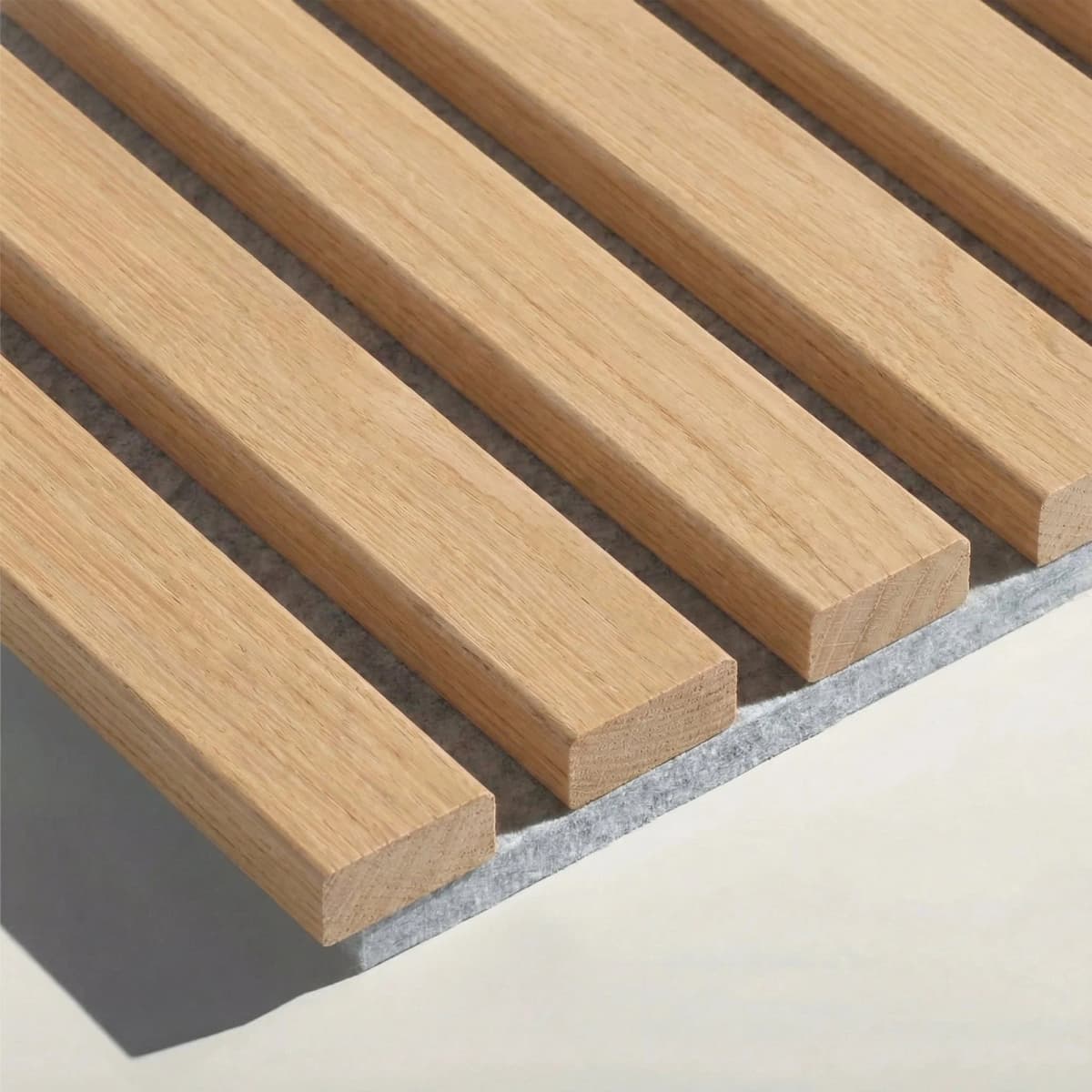
The slim, regular vertical lines of acoustic slat panels suit minimalist interiors well. The rhythm is repetitive — and repetition, in minimalism, creates calm rather than monotony. Choose a species with fine, even grain (ash, pale oak) over one with dramatic figure (walnut, olive). Keep the slat profile slim — 20–25mm slat width with proportionate gaps. For the most restrained palette, the White Felt acoustic slat panel pairs pale timber with white backing felt — the felt remains visible through the slat gaps and reinforces the light, minimal character.
Large-Format Smooth Panels
For the most minimal possible wall treatment, large-format smooth panels (either solid colour or subtly grained veneer) with minimal or concealed joints create a wall surface that reads as a single, uninterrupted plane. The scale eliminates the visible pattern of smaller panel systems, leaving only tone and texture.
Reeded Panels
Reeded panels — with their soft, rounded parallel ridges — offer texture without pattern. The surface catches light differently at different times of day, creating subtle visual interest without adding colour or form. In white or off-white paint, reeded panels are one of the most successful minimalist wall treatments available. See our reeded panel guide for style and installation details.
The One-Wall Rule
Minimalist interiors typically work with one panel wall per room — the primary feature wall that anchors the space. Additional panel walls dilute the impact and create visual complexity that contradicts the minimalist brief. Choose the right wall (usually the wall you face from the primary seating position, or the wall behind the bed) and execute it perfectly.
Colour in Minimalist Panel Schemes
Minimalist doesn’t mean colourless — but it usually means restrained. The most successful minimalist panel schemes work in one of two directions:
- Natural wood against neutral walls: Natural oak or ash panels against warm white, soft grey, or greige walls. The wood is the only colour statement; the walls support rather than compete.
- Tone-on-tone: Wood panels in a muted tone — warm grey, soft green, pale terracotta — against walls in a very similar but slightly different tone. The wall reads as nearly monochrome but with a subtle textural layer from the paneling.
For a broader look at how to make a feature wall work without adding visual clutter, our accent wall ideas guide covers the design principles behind restraint in feature wall design.
Getting Minimalist Panels Right: The Practical Details
Minimalist panel design is more demanding to execute well than maximalist schemes, because there is no complexity to hide imperfection behind. Every join, every gap, every board end is fully visible. This means minimalist panel installations reward investment in quality: quality boards with consistent dimensions, quality installation with laser-level precision, and quality finishing with properly filled nail holes and cleanly caulked joints.
The installation sequence matters in a minimalist interior. Mark the wall centre before the first board goes up, work outward symmetrically, and set the height of any horizontal cap rail or floor-to-ceiling boundary with a spirit level rather than by eye. In a minimalist room, a cap rail that is 3mm off level over a 3-metre run is visible. In a maximalist room, it disappears in the visual complexity. Minimalism makes the craftsperson’s precision either the quality or the failure of the installation.
Material selection should be equally considered. In minimalist spaces, the panel is the decoration — which means it needs to be genuinely interesting to sustain visual attention on its own. A bland, featureless panel in a non-descript species reads as emptiness rather than restraint. Choose species with quiet but genuine character: straight-grained ash with fine movement, pale oak with a soft figure, or smoked eucalyptus with subtle tonal depth. The material should be interesting enough to hold a room without any help.
Minimalist Wall Panel FAQs
Can I have patterns in a minimalist panel scheme?
Yes — restraint in a minimalist interior refers to quantity and complexity, not the complete absence of visual character. A board-and-batten pattern in a single tone, for instance, creates rhythm and visual interest through geometry without adding colour or material contrast. The discipline is in executing the pattern cleanly and keeping everything else — furniture, textiles, accessories — very simple.
What colour should minimalist wall panels be?
Natural, unlacquered wood tones work well in warm minimalist schemes. For cool minimalism, white or off-white painted panels on a white wall — tonal, low-contrast, almost invisible — create architectural definition without visual noise. Avoid strong panel colours in a minimalist interior unless the panel is the only deliberate colour statement in the entire room.
How many panels are too many in a minimalist home?
One feature wall per room is the standard minimalist approach. In an open-plan layout, this might mean one panel wall visible from the main living zone, with nothing on the adjacent kitchen or dining areas. In a bedroom, the headboard wall. In a hallway, a single side. The discipline is in choosing which wall most benefits from the treatment and having the confidence to leave the others bare.
Do minimalist panels require special maintenance?
Minimalist panels in natural oiled finishes require annual re-oiling to maintain the finish and prevent the wood from drying out. Painted minimalist panels need touch-up painting every few years or when visible wear develops, and benefit from a full repaint every seven to ten years. The maintenance regime is the same as for any quality panel — the minimalist aesthetic simply makes the condition of the finish more visible.