
Table of Contents
The Most Misunderstood Distinction in Wall Panels
Walk into any home improvement store or browse wall panels online and you’ll see two very different products often described with similar language. “Wood wall panels” can mean anything from genuine real-wood-veneer over engineered MDF to a photograph of wood grain printed on PVC film. The difference in quality — and the difference in how they look, feel, and perform over time — is enormous.
Here’s a clear breakdown.
What Is Real Wood Veneer?
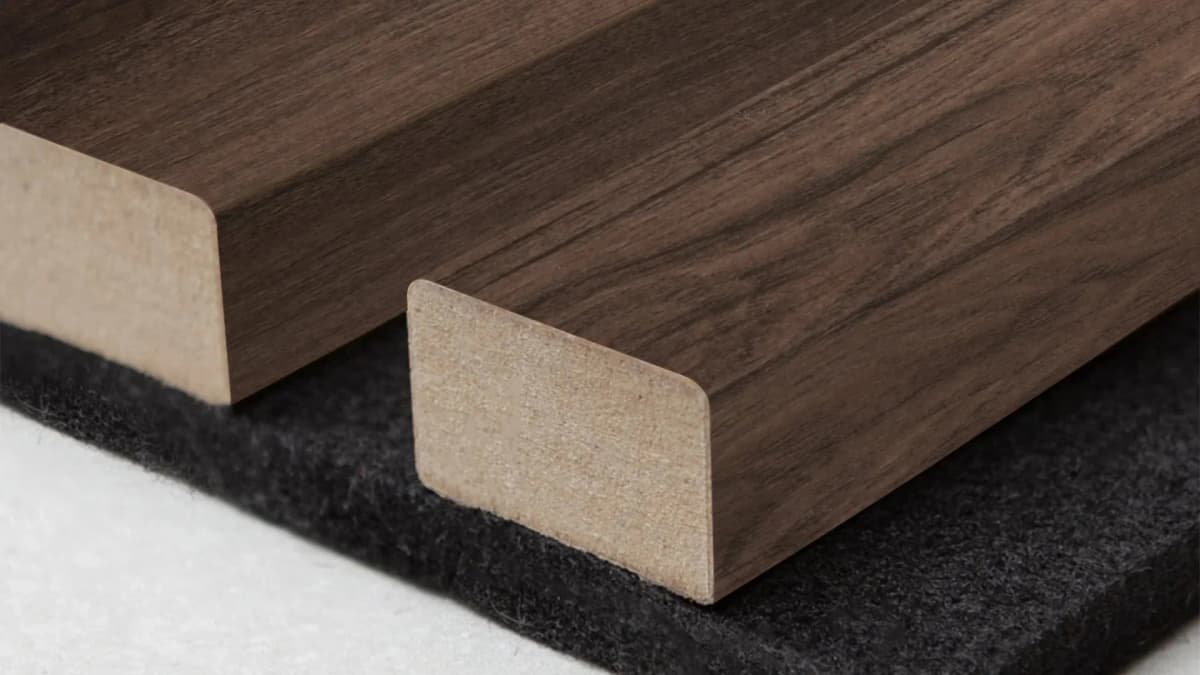
Real wood veneer is an ultra-thin slice of genuine timber — typically 0.6mm to 2mm thick — cut from a real log and bonded to an engineered substrate (usually MDF). The grain, colour, and character are authentic because they come from an actual tree. No two veneer panels are identical, because no two pieces of timber are identical.
The substrate provides dimensional stability and consistency, while the veneer provides the authenticity and appearance of solid timber at a fraction of the weight and cost.
What Is Laminate?
Laminate is a photographic or printed image of wood grain (or any other pattern) bonded to a substrate — typically MDF, HDF, or PVC. High-quality laminate can be convincing from a distance, but it’s a reproduction, not the real material. The same pattern repeats across every panel from the same batch because it’s printed, not grown.
How to Tell Them Apart
- Touch the surface: Real veneer has micro-texture from genuine wood grain — you can feel the difference. High-gloss laminate is perfectly flat regardless of what the pattern suggests.
- Look at the edges: Real veneer panels show the engineered core at the edge with a thin veneer layer visible. Laminate panels often show a printed edge or PVC edge tape.
- Check for pattern repeat: Lay two panels side by side. If the grain pattern repeats identically, it’s laminate. Real veneer has continuous, non-repeating grain variation.
- Smell it: Real wood veneer has a faint, genuine timber scent. Laminate and PVC panels have no scent or a faint plastic smell.
Head-to-Head Comparison
| Feature | Real Wood Veneer | Laminate |
|---|---|---|
| Appearance | Authentic grain, natural variation | Printed reproduction, pattern repeat |
| Touch/texture | Genuine wood texture | Flat regardless of print |
| Durability | Can be sanded and refinished | Cannot be repaired — replace only |
| Ageing | Develops patina gracefully | Can peel, fade, or bubble over time |
| Sustainability | FSC-certified options widely available | PVC laminates are not recyclable |
| Cost | Higher | Lower |
| Weight | Slightly heavier | Lighter |
When Laminate Makes Sense
Laminate wall panels aren’t inherently bad — they just need to be chosen for the right application:
- High-moisture areas where real wood would be unsuitable
- Temporary installations or rental properties
- Very large coverage areas where budget is the primary constraint
- Feature walls where the panel is viewed from a distance and touch-texture doesn’t matter
When Real Wood Veneer Is Worth the Premium
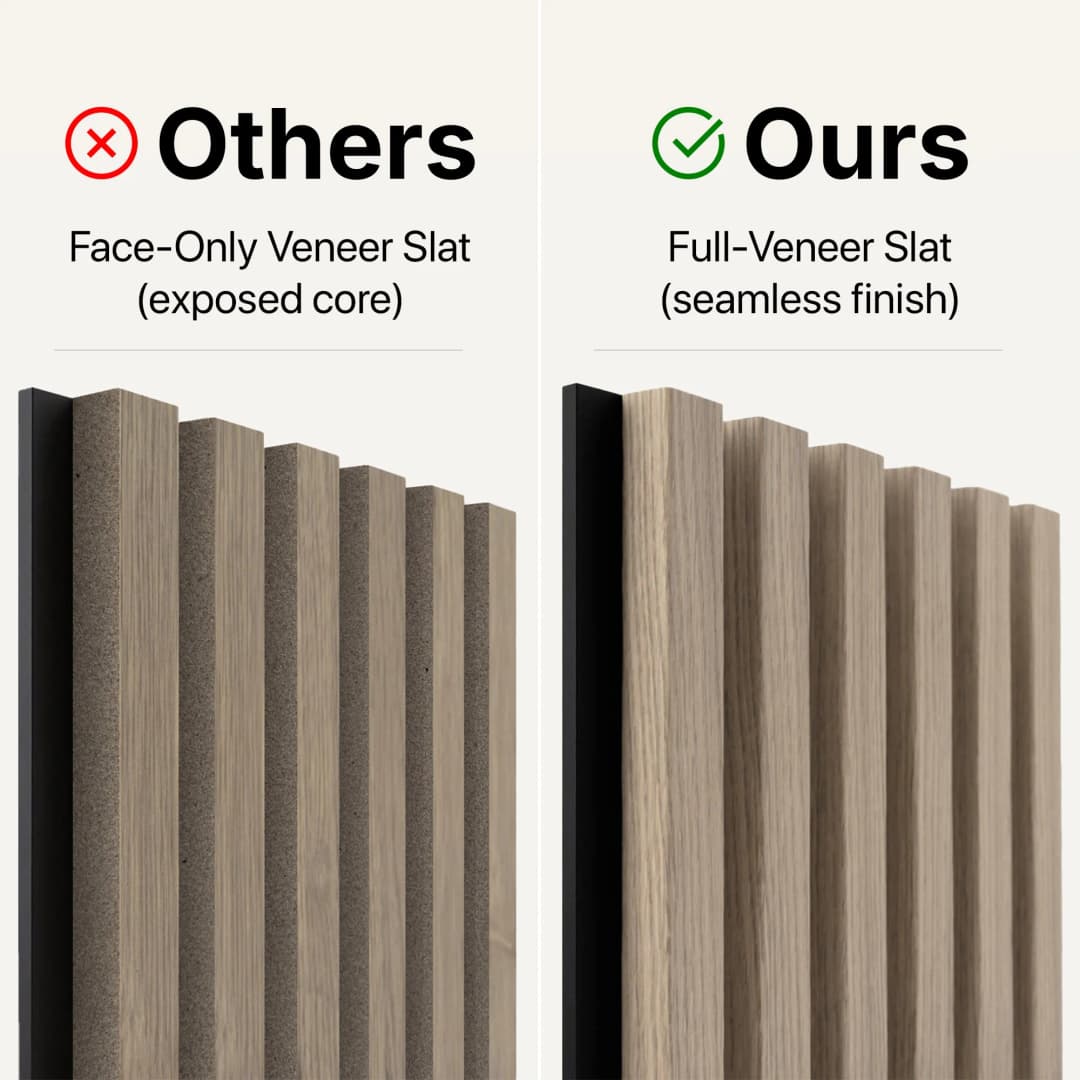
Real wood veneer panels are the right choice when:
- The wall will be seen and touched at close range
- You want the wall to age authentically and develop character
- Acoustic performance matters (veneer panels pair properly with felt backing; laminate panels often don’t)
- The installation is intended to last 10+ years
- Sustainability and FSC certification are part of your decision criteria
For more on wood species choices in real veneer panels, our guide on the best wood for wall panels covers walnut, oak, ash, and others in detail. And if you’re comparing wood panels to other wall treatments altogether, the wall panel vs wallpaper vs paint comparison puts the full picture in context.
Verdict
If you’re installing a feature wall in a living room, bedroom, or office — somewhere you’ll look at and touch every day — real wood veneer panels are worth the premium. The authenticity, durability, and ageing characteristics are simply not replicable in print. For less prominent areas or budget-constrained projects, quality laminate is a reasonable second choice — but know what you’re buying before you spend.
Real Wood Veneer vs Laminate FAQs
Can laminate wall panels look as good as real wood veneer?
Modern laminate printing technology has improved dramatically — high-resolution photographic prints at 0.2mm resolution can create convincing wood-look surfaces that fool a casual observer from across a room. However, at close range, the uniformity of a printed repeat pattern becomes apparent in ways that genuine wood grain does not. Premium laminates with embossed surface texture are more convincing tactilely than flat-surface laminates. If budget allows, real wood veneer is always the more convincing and more durable specification.
Does real wood veneer add more value to a property than laminate?
Estate agents and valuers consistently distinguish between authentic and imitation materials. A real wood veneer panel installation reads as a premium finish that adds perceived value; a laminate installation in the same profile reads as a budget treatment. In a sale context, the cost premium for veneer over laminate in wall panels is typically small relative to the difference in perceived quality it communicates to prospective buyers.
How thick is a typical real wood veneer on wall panels?
Quality real wood veneer for wall panel applications runs between 0.5mm and 1.0mm. Veneers below 0.3mm are technically real wood but are too thin to be refinished, repair themselves, or show meaningful depth of grain. Veneers of 0.6mm and above are considered quality specifications — they can be lightly sanded if surface scratches develop, show genuine grain depth and colour variation, and age authentically over time. Always ask for the veneer thickness specification before ordering.
Is laminate always cheaper than real wood veneer?
At entry level, yes. Basic laminate panels are significantly cheaper than real veneer panels in equivalent profiles. However, at the premium end of the market, high-quality laminate (with embossed texture, multi-layer construction, and realistic print quality) costs nearly as much as mid-range real veneer panels. At that price point, real veneer is almost always the better specification: you get genuine material performance and ageing properties for a comparable or marginally higher investment.
Shop Real Wood Veneer Panels
Browse the complete wood wall panel collection at The Panel Hub — all products in the SoundPanel™ acoustic slat range use genuine real wood veneer, not laminate or foil wrap. Order a sample to compare the difference in your own lighting conditions before committing. For room-by-room design inspiration, our interior slat wall ideas guide covers 50+ real-room applications using veneer-faced panels. The acoustic panel buyer’s guide covers veneer specifications and what to look for in a quality acoustic slat panel product.