
Table of Contents
- The MCM-Panel Connection
- Species: Walnut Is Non-Negotiable
- Profile: Vertical Slats or Horizontal Planks
- Scale and Placement
- Complementary Elements
- What Breaks the MCM Effect
- Fitting MCM Panels: What to Get Right on Installation Day
- Mid-Century Modern Wall Panel FAQs
- Shop Mid-Century Modern Wall Panels
The MCM-Panel Connection
Mid-century modern design (roughly 1945–1970) was obsessed with wood. Walnut, teak, and rosewood appeared on every surface — furniture, ceilings, walls, and floors. The use of vertical timber battens and slat screens as room dividers and feature walls was a defining architectural detail of the period. Today’s acoustic wood slat panels are a direct contemporary evolution of this tradition.
Getting MCM wall panels right isn’t about copying period interiors — it’s about understanding the principles that made them work and applying them with contemporary materials.
Species: Walnut Is Non-Negotiable
Mid-century modern design is built on walnut. The rich chocolate tones with warm reddish-brown undertones are inseparable from the aesthetic — they appear in virtually every authentic MCM interior. Oak is too light; teak is too specific in its associations; pine is too rustic.
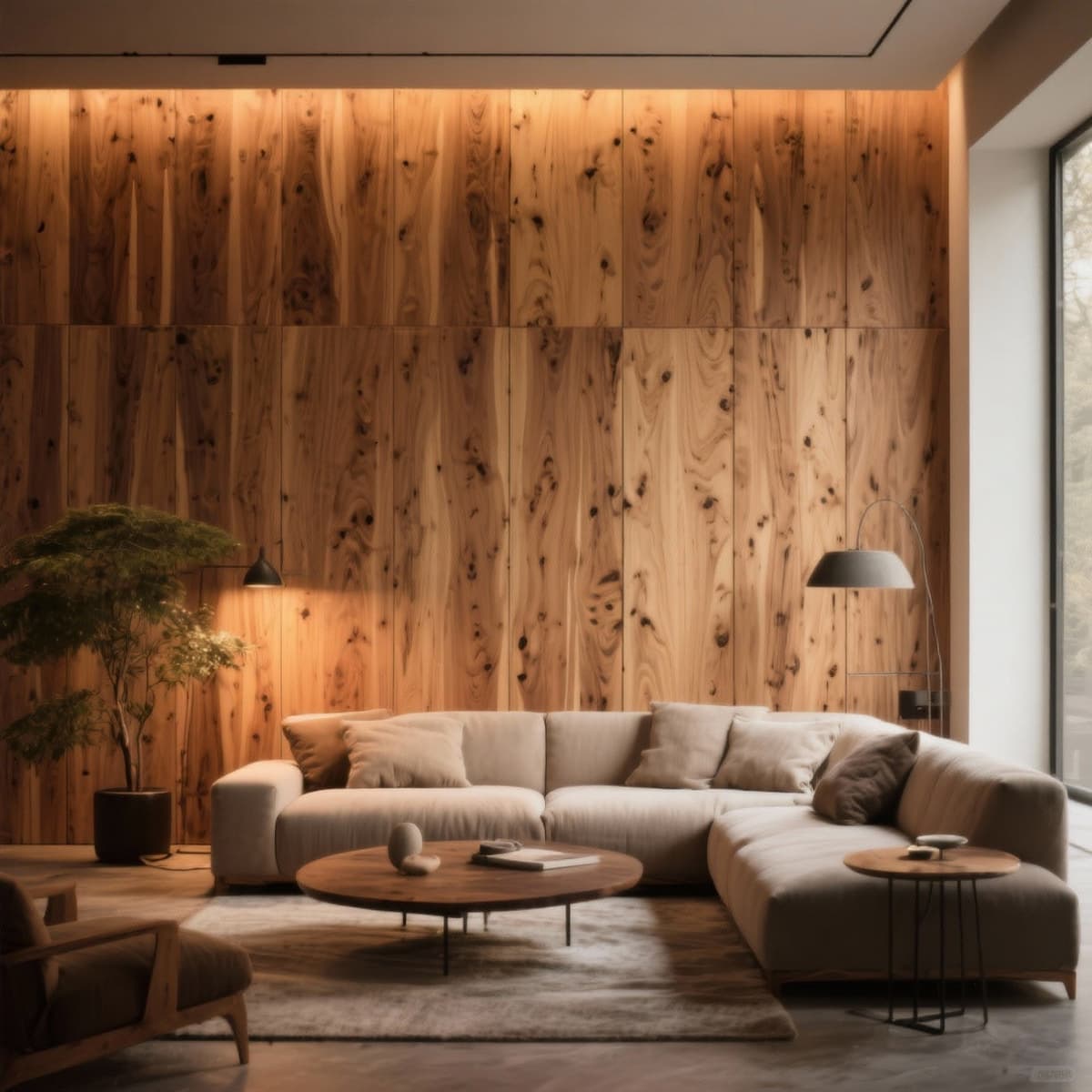
For MCM wall panels: walnut is the first choice. A walnut acoustic slat panel wall immediately reads as MCM-adjacent without any other contextual cues. Our walnut vs oak comparison covers the specific visual differences that make walnut the MCM choice, and our wood species guide covers walnut’s characteristics in detail.
Profile: Vertical Slats or Horizontal Planks
MCM interiors used two primary panel orientations:
- Vertical battens: Slender vertical slats, often in walnut or teak, creating the screen-like room dividers and feature walls seen in mid-century architecture. Contemporary acoustic slat panels in a walnut finish are essentially a faithful reproduction of this detail.
- Horizontal planks: Wide horizontal timber cladding — like shiplap but in premium species — used for feature walls in living rooms and bedrooms. More rustic in character than vertical slat panels.
For the most authentic MCM result, vertical slat panels in walnut at a proportionally slim slat width (20–30mm) are the correct choice.
Scale and Placement
MCM wall panels work best in rooms with enough scale to carry them. A full floor-to-ceiling walnut slat wall in a living room with generous ceiling height (2.6m+) is one of the most striking MCM-influenced results you can achieve in a contemporary home. In a room with lower ceilings, limit the panel to the primary feature wall only and ensure the slat profile is slim enough to avoid making the wall feel heavy.
Complementary Elements
The walnut panel wall works best alongside:
- Furniture with tapered legs and clean lines — the essential MCM silhouette
- Warm amber and ochre tones in soft furnishings
- Brass or brushed gold hardware and light fixtures — the quintessential MCM metal
- Abstract art in warm tones hung directly on the panel wall (MCM interiors were not shy about art on wood walls)
- Terrazzo, statement tile, or polished concrete floors — contrasting hard surfaces that highlight the warmth of the walnut
What Breaks the MCM Effect
- Grey tones of any kind — grey panels, grey furnishings, grey flooring all conflict with the warm amber palette
- Industrial or raw materials — exposed concrete walls, visible steel — the wrong direction entirely
- Chrome hardware — silver metal tones undercut the warmth of walnut; brass and bronze are the correct metal family
For how to source and specify walnut panels specifically, the complete wood wall panel guide covers material specifications and what to look for in a quality walnut veneer product.
Fitting MCM Panels: What to Get Right on Installation Day
Mid-century modern design is unforgiving of imprecision. The aesthetic is built on honest construction and the deliberate expression of how things are made — so panels that are visibly poorly fitted or that have inconsistent gaps undermine the entire premise. When fitting MCM wall panels, invest time in the preparation: true the wall before installation begins, use a laser level to establish a perfectly plumb first board, and work from the centre of the wall outward to balance any variations at the edges.
For vertical slat panels (the most authentic MCM choice), ensure each slat is independently plumb rather than assuming the adjacent slat is correct. Over a 2.4m run, a single slat that is 2mm out of plumb will visually deviate from the panel line enough to be noticeable at normal viewing distances. Take the time to check each board independently — this is the work that separates professional-looking MCM installations from amateur attempts.
Finish the installation with a compatible skirting and ceiling trim in walnut or stained timber that relates to the panel species. MCM interiors typically avoid painted white trim — it breaks the tonal continuity of the wood. A stained timber skirting that matches the panel species creates the seamless, cohesive transition that MCM design requires. If you are installing panels in an older property where the existing skirting cannot be changed, paint it in a deep, warm neutral (charcoal, warm grey) rather than white.
Mid-Century Modern Wall Panel FAQs
What is the most important panel specification for a genuine MCM result?
Species. Walnut is the single most important decision in an MCM panel scheme — no other wood carries the same tonal association with 1950s and 1960s American and Scandinavian interiors. If walnut is beyond budget, a mid-toned, well-grained oak stained to a warm brown is the next best option. Avoid pale ash, dark ebonised finishes, or painted panels, which all push away from the authentic MCM palette.
Do MCM wall panels work with modern furniture?
Yes — and this is one of the design advantages of MCM panelling. The aesthetic reads as timeless rather than period-specific, which means it integrates well with contemporary furniture that has MCM-adjacent proportions (low profiles, tapered legs, simple upholstery). Where it conflicts is with very high-gloss contemporary furniture or with ultra-minimalist pieces that have no material warmth.
Can MCM panels be installed in a 1970s or 1980s home?
Absolutely. The materials and proportions of MCM design translate naturally into homes built in any decade with similar ceiling heights and room volumes. The key is to avoid referencing the dated aspects of 1970s panelling (dark, heavy, wall-to-wall coverage in small rooms) and instead apply the MCM approach selectively: one feature wall, properly proportioned, in an appropriate species.
How do I integrate MCM panels with a fireplace wall?
A fireplace wall is an ideal location for MCM slat panelling. Carry the panel across the full width of the wall, with the fireplace sitting as an inset element within the panelled surface. Ensure the panel runs continuously through the chimney breast, over the fireplace opening (using fire-resistant boards in any zone immediately adjacent to the firebox), and down to floor level on both flanking walls. This treatment is the most direct reference to the integrated MCM interior design of the 1950s Californian Case Study houses.
Shop Mid-Century Modern Wall Panels
Browse the full wood wall panel collection at The Panel Hub — the SoundPanel™ acoustic slat range in walnut is the most direct contemporary expression of the mid-century timber batten tradition. For room-by-room inspiration showing how walnut slat panels translate into finished MCM interiors, our interior slat wall ideas guide covers 50+ real-room applications. The acoustic panel buyer’s guide explains the acoustic felt backing system that gives modern slat panels a performance dimension the original MCM batten screens never had.